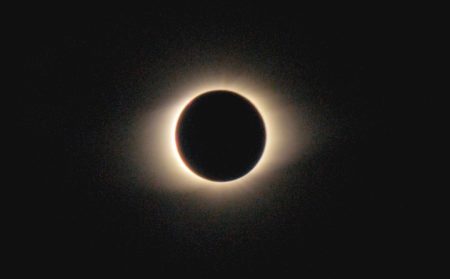
The recent total eclipse got me thinking—not only about the event itself, but about the concept of an eclipse. They’ve been around as long as we have. To our distant ancestors, they were scary things. People in ancient China thought a cosmic dragon was trying to devour the sun. In response, they made as much noise as they could to scare the dragon away (Lightman).
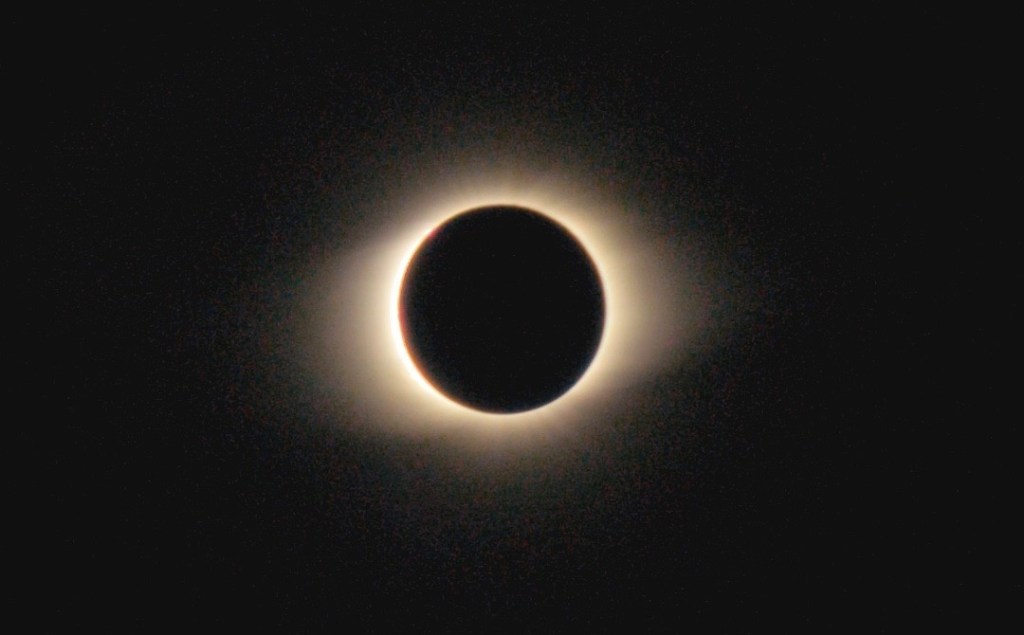
We understand today that a solar eclipse is what happens when they moon passes between Earth and the sun. But there’s a little more involved to it than just that. Katrina Miller, science reporter for the New York Times, put it this way:
Our moon is about 400 times smaller than the sun, but it is also 400 times closer to Earth. This makes the two appear to be the same size from our point of view.
That’s important. In fact, it’s the key to a total eclipse—because otherwise there would be no way for a smaller object like the moon to obscure an object 400 times its size. But there is and it does.

Understood in this context, it also explains why an eclipse can be such a powerful concept—something small obscuring something large. It happens all the time if you think about it. The more dramatic among us are masters of this. They are able to make the smallest problems seem as if they are too big to fit in the universe. Even the less dramatic do this at times. It used to be called “making a mountain out of a molehill.” Now we just say someone is “blowing something out of proportion” (less colorful, more technical).
This also spills into the spiritual realm as well. We understand that God is not just big—He’s infinite. He’s omnipotent, omniscient, and omnipresent (see Psalm 139). There is nothing remotely comparable to Him. Nonetheless, we all wrestle with the reality that from time to time, we allow things to eclipse God. A ridiculous idea in theory, but in reality, something we must guard against.
A spiritual eclipse might take the form of idolatry—where we elevate something to an importance above God (Colossians 3:5). Or it could be something opposing us (a disease, an exasperating and enduring set of circumstances) that seems to become more powerful than God.

Biblical illustrations of spiritual eclipses abound. There’s Pharoah asking, “Who is the Lord that I should obey Him” (Exodus 5:2). He was under the illusion that he ran the show in Egypt, and no one could oppose him. There’s the group of false prophets on Mt. Carmel who believed that Baal was supreme and could rain down fire from heaven (1 Kings 18). Or, what about Nebuchadnezzar (who certainly knew better), thinking he was the true force behind his kingdom and power (Daniel 4)?
When we watch an eclipse, there are special glasses we must wear to keep us from damaging our eyes. In the case of a spiritual eclipse, we need something to correct our vision because we’re not seeing things as they really are. This is why Paul prayed:
I pray that the eyes of your heart may be enlightened in order that you may know the hope to which he has called you, the riches of his glorious inheritance in his holy people, and his incomparably great power for us who believe. (Ephesians 1:18-19).
Nothing eclipses God!

