
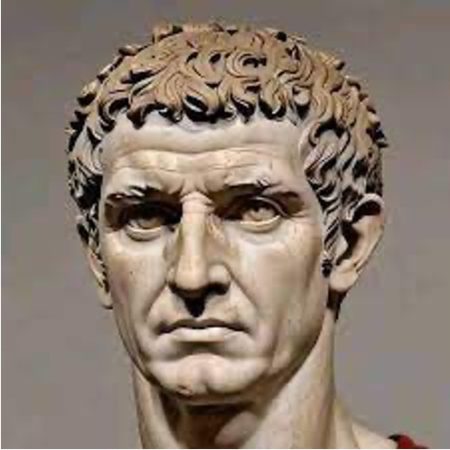
Imagine two Jewish disciples meeting on the road to Rome around AD 55. They’re both traveling with their families. It’s been over five years since they were forced to leave the city after Claudius issued an edict expelling all Jewish people (Acts 18:1-3). But Claudius has died, so Jewish people are headed back to Rome.
Mordecai: Ezra my brother! Praise the Lord! How long has it been since I’ve seen you? How good to see you and your family—look how your children have grown . . . I don’t even recognize them.
Ezra: Yes, my friend. I wondered if I would ever see you again in this life. And from the looks of it, our children are just trying to keep up with yours.
Mordecai: Well, never again will our families be separated. The evil Claudius is no more, and his successor will treat us better and give us the peace for which we long. We have no more worries now.

Ezra: Yes, I pray you are right. And remind me, what is the name of our new deliverer?
Mordecai: His name is Nero.
Maybe this conversation (or something like it) occurred or maybe it never did. Count me in the group that believes it did.
I think this because too many times over the years, I’ve seen disciples (myself included), voice the belief that once their candidate/party gained control—everything would be fine. There seems to be something in human nature (our trusting/optimistic nature, which is good) that makes us lean in this direction. Our first century brothers and sisters at Rome learned in the most brutal manner imaginable not to put their hope in an earthly kingdom. Claudius may have been no picnic for the Jewish believers, but he was nothing like the monster that Nero became.

While it’s true that some rulers and governments might be faith friendlier than others, ultimately, they all operate on a different set of principles than the kingdom of Jesus (John 18:36). So, while the Jews might have been treated better by the Persians than the Babylonians, it didn’t stop Xerxes from issuing his genocidal decree (fortunately amended later (Esther 8-9). And while Darius might have been a better king than other Babylonian rulers, it didn’t stop him from throwing Daniel into the lions’ den. And even though Pilate knew Jesus was innocent (Mark 15:10; John 18:38; Luke 23:4), it didn’t stop him from having Jesus executed—because in the end his interest was in what would further his agenda.
But these are all examples from thousands of years ago and don’t apply to today. Yes, many of us are blessed that our situation is different. But if you’re paying attention, you know there are sadly plenty of places on our planet where people of faith suffer violence, oppression, and persecution. But even in those places where they are not, governments and politicians continue to pursue their agendas rather than the kingdom of God and we shouldn’t expect that to change.
Where does this leave us?
I badly need to balance this piece out by saying that governments serve an important function in establishing law and order. Scripture makes it clear that we’re to appreciate their role and function and support them in whatever is not contrary to God’s will. Paul develops this in Romans 13:1-7 while Peter addresses it in 1 Peter 2:13-17. These responsibilities are not presented as optional but essential. We need to support good men and women who serve us in this capacity. Our problems begin when we overreach and expect from government what only God can give us in the kingdom of His Son.
But our citizenship is in heaven. And we eagerly await a Savior from there, the Lord Jesus Christ, who, by the power that enables Him to bring everything under His control, will transform our lowly bodies so that they will be like His glorious body. (Philippians 3:20-21)
 A Taste of Grace with Bruce Green