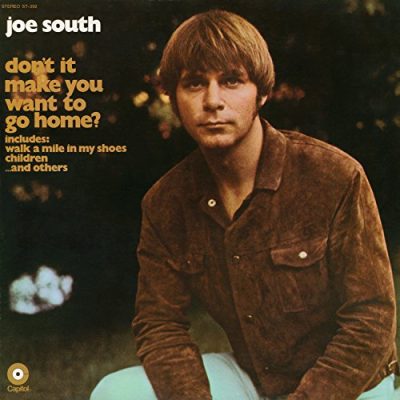

I was seriously into popular music when I was growing up (it was my “Bible” before I knew about the real Bible). One of my favorite musicians to listen to was Joe South. It wasn’t his real name (that was Joseph Alfred Souter), but it was a great name for someone who was from the South and sang about things that were evocative for all people—but especially people those who were southerners. After all, just his name gave him an inside track.
Joe South was from Atlanta and I grew up just a few hours up the road in north Alabama. He was a songwriter, singer, and a studio musician—probably in that order. Before Brook Benton, Glen Campbell, or Al Green recorded Don’t It Make You Want to Go Home, it was Joe South’s song. His voice resonated with an authenticity that made you feel like he knew exactly what he was singing about.
His career peaked in the late sixties and early seventies. It was a time not unlike our present in that there was a good deal of social unrest. A controversial war was being fought, schools were being desegregated, there were racial tensions, and people were always meeting and marching in protest to something. Joe South touched upon the need for people to push past their differences and come together in songs like The Games People Play and Walk A Mile in My Shoes.

In the latter song, South called on people to do just that—to learn to see the world through the eyes of others rather than just their own. He got right down to the problem when he wrote:
And yet we spend the day throwing stones at one another,
‘Cause I don’t think or wear my hair same way you do.
Well I may be common people, but I’m your brother,
And when you strike out and try to hurt me, it’s hurting you.
We belong to each other! We live on the same planet. We have the same Father. We are part of the same family. What a difference it would make if we would remember that about each other before we thought about our differences.
What if we tweaked our speech just a little? Instead of saying, “disabled person,” “veteran,” “black person” or “white person,” we started saying “person who is disabled,” “person who is a veteran,” “person who is black,” and “person who is white?” What if we just saw everyone as person before we saw them in any other way?
For us to live with this understanding is what God desires. When Jesus talked of those who were strangers, in prison, hungry, homeless or hurting, He spoke of them as His “brothers and sisters” (Matthew 25:40). He showed solidarity with them because He recognized that whatever else they were, they were people first. They were part of the human family therefore they were part of His family.
This won’t solve all our problems by any means, but it is a productive place to start. It is also an excellent place to return to as the need arises.

