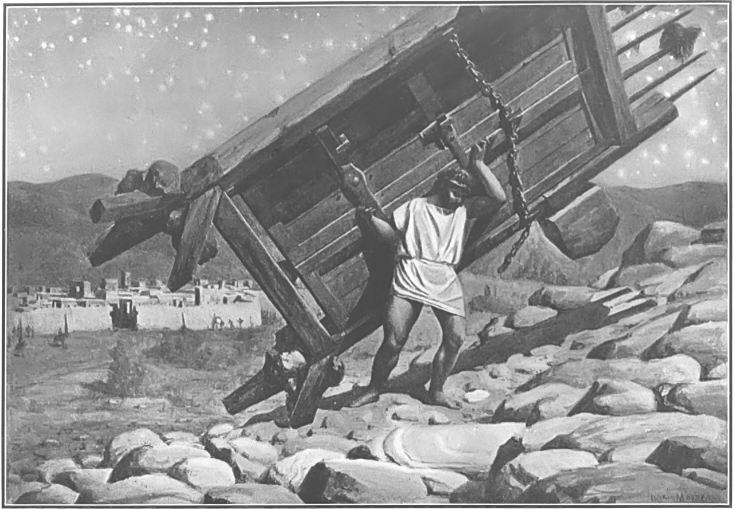
One of my favorite pictures of the resurrection comes from the Old Testament book of Judges. It is the story where Samson is inside the city of Gaza (Judges 16). His enemies are outside the gates of the city. They are convinced they finally have Samson cornered—they’ll just wait by the gates until he comes out the next morning. He can’t possibly escape their grasp this time!
Ahh, but he does. Samson gets up in the middle of the night, rips the gates from their posts and walks off, carrying them with him! Most of us have seen pictures of city gates and know how enormous they were. Samson must have looked the way an ant does when it carries something several times its size. Off he goes, all the way to the top of the hill facing Hebron. What a sight that must have been!
After the glorious confession of Peter at Casearia Philippi, Jesus spoke of gates when He told Peter He would build His church and “the gates of Hades will not overcome it” (Matthew 16:18). This verse is often explained to mean that Satan cannot defeat the people of God—the church will always be around no matter how bad things get. While this is true in principle and it makes for good preaching, I’m not sure that’s what Jesus meant.
To help us understand what He was saying we must understand that Hades is not the same thing as hell. Hades was where, prior to the resurrection of Jesus, a person’s spirit went after death—regardless of whether they had been ungodly or righteous. When Jesus told the story of the rich man and Lazarus (Luke 16), both their spirits went to Hades after their deaths. The rich man ended up in the part of Hades where there was suffering and Lazarus in the part where there was comfort. (They are presented as having “bodies” only to help us relate to their comfort/discomfort). Hades was then an intermediate place of waiting that was neither heaven nor hell.
Christ too went to Hades when he died (the Greek in Acts 2:27 is better transliterated as “Hades” than translated as “grave” or “hell”). He told the penitent thief on the cross that he would be with Him that day in “paradise” (Luke 23:43). Evidently, paradise was a way of referring to the part of Hades where there was comfort.
Christ went to Hades, but unlike anyone else who had gone before, He didn’t remain there. He couldn’t. “It was impossible for death to keep its hold on Him” (Acts 2:24). He went to that city swollen with the spirits of all who had gone before. The gates rang shut behind Him as they had on all others—only this time they didn’t stay shut. Like Samson, He tore them right off their hinges and marched away! The grave could not hold Him!
Forty days after His resurrection, Jesus ascended into heaven. He sent the Spirit as He said He would. The church began as He had promised. The “gates of Hades” were unable to stop Him and neither can anything else.
No one who belongs to Jesus gets the gate shut on them!

