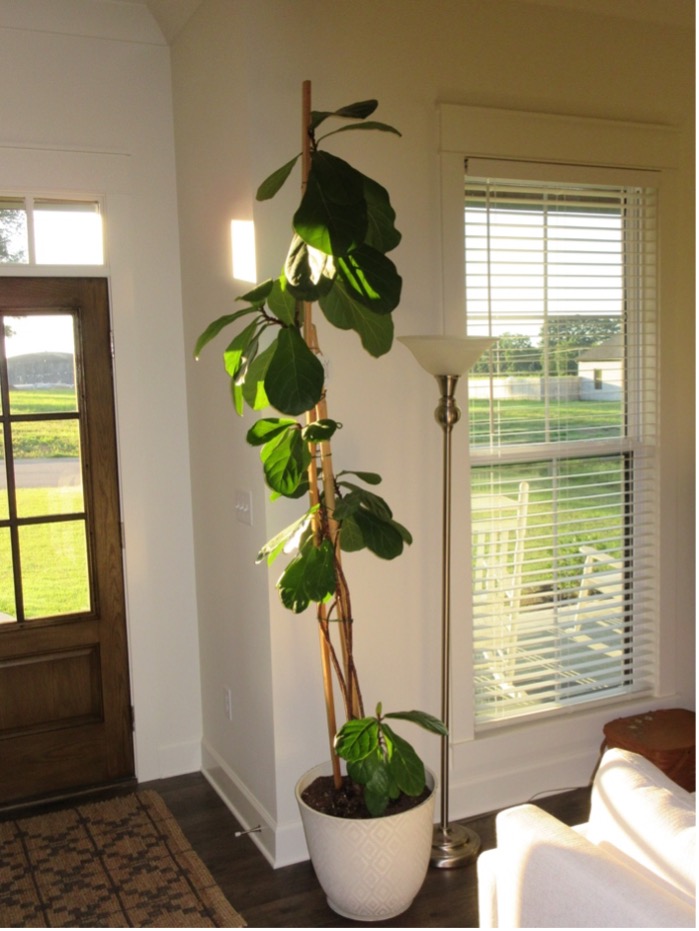
This is a Fiddle Leaf Fig (FLF)—and this particular plant has quite a story. We acquired it more than 30 years ago when someone sent it for my father’s funeral. After the service, when the flowers and greenery were being parceled out, someone offered it to us and we took it. It was maybe a foot high (and a foot wide) with lots of beautiful leaves—that’s what I remember about it. And of course, Janice and I both liked the idea of taking the plant as a way of connecting us to the moment in time when we said goodbye to Dad. Neither one of us had any idea of what the FLF required or how we would take care of it. At the time, we were living in Spanish Fort, Alabama.

Well, the plant survived its first year and journeyed with us when we moved to Cabot, Arkansas, and then 15 years later when we went back to Alabama in 2010 (this time to Opelika). Recently, it went back with us to Arkansas when we moved to Searcy. (My apologies if all this moving back and forth is making you dizzy). Anyway, by this time the plant was about 7 feet tall. My wife (the plant whisperer), put all her plants into her Forrester (about a dozen of them). I’m not sure physics would be useful in explaining exactly how she managed to accomplish this, but she did. What’s more, she drove 9 hours this way! Anyway, by the time we arrived in Searcy, the FLF was looking quite a bit worse for wear. It was bent over, its leaves were drooping—I wasn’t sure if it was going to survive.
The picture at the top of this post was taken a month after our arrival in Searcy. As you can see, the plant isn’t there yet, but it’s doing much better. I was amazed at its comeback and said as much to Janice. She matter of factly told me it wasn’t that amazing—all it needed was little support and some time to recover. I do a fair amount of reading and writing, so I know a good line when I hear one—and that was a good line!
“A little support and some time to recover”—Isn’t the same thing true for most of us when we struggle?
Yet when someone hits the skids, is it our first inclination to do what I did with the plant and offer a bleak assessment and conclude the worst for their future? There’s nothing hopeful or helpful in such a posture! This is why the Spirit led Paul to tell the disciples at Thessalonica to “encourage the disheartened, help the weak, be patient with everyone” (5:14). Give them support. Give them some t-i-m-e. Do the kinds of things for them that others have done for you. Much of the time, that’s all they need.
I’m here today and so are you because we’ve had lots of people who cared for us. Our parents, relatives, friends, teachers, coaches . . . it’s a long line when you think about it. No one is called to be everything to everyone, but we’re all called to be something to those who need us.
Let’s make sure we get in that line.
 A Taste of Grace with Bruce Green