
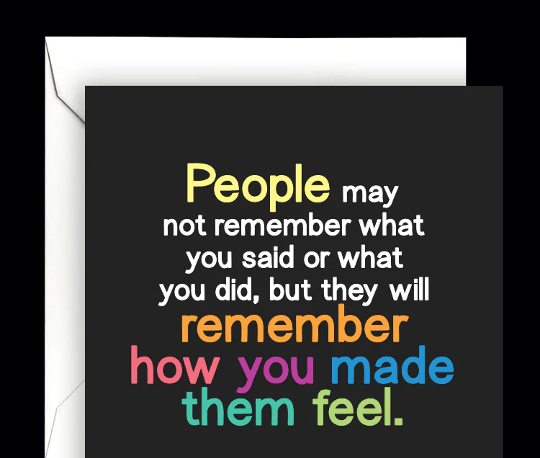
Most of us are familiar with the quote above. I think it says at least a couple of important things. One is that it reminds us of the important role emotions play in remembering something. Odors and music may bring to mind where we were when we first smelled the aroma or heard the song, but emotions can act as an almost unconscious evaluator of an experience or another person. If it/they made us feel good, we have good memory and if it/they didn’t we have a bad memory.
The second point flows from the first—if we’re not judicious, we can easily become a prisoner of our emotions. By that I mean that we can allow how we felt to become the dominant or only memory we have of something or someone. We can fail to intellectually or spiritually engage in anything deeper.

For example, when each of our three children were in the toddler stage, they all went through similar experiences with dogs. We didn’t have one then, so the first few times they saw a dog at someone’s house or at the park, they went wild and wanted to pet the dog, interact with it, etc. Well, at some point they did and the dog was . . . well, a dog. It went beyond the comfort zones of our kids and the screams of delight turned into just screams. After that, they were scared of dogs. Why? Because they remembered the way the dogs made them feel. That’s what we do when we’re young and our frontal lobe hasn’t fully developed.
But that’s not where the story ended. After our youngest child was out of the toddler stage, we got a couple of beagles. Each of our children worked through whatever negative feelings they might have still had and grew to love the dogs. They didn’t allow their past emotions to imprison them.
Whenever I see the quote I started this piece with, I wonder if this doesn’t contribute to our culture’s already unhealthy elevation of emotions to the point where they often function as the primary arbiter in how we look at things. If something makes us feel good we like it, if it doesn’t, we don’t and avoid it like the plague—and that’s where the story ends. That’s not a very mature way to think or a healthy way to live. (Can you imagine a medical professional, teacher or judge accepting or rejecting something based on the way it made them feel?).
Think of Jospeh. His brothers did all kinds of things to him—they threw him into a well, sold him into slavery, and told their father he was dead. So when their cross paths years later, Joseph wanted nothing to do with them because he remembered how they made him feel bad, right?
Hardly.
Joseph actively pursued a relationship with his brothers. He understood that looking at his past strictly through the filter of his emotions wasn’t a healthy thing to do. He learned to looked at his past through the grace of God. This didn’t replace his emotions, because anyone familiar with the story knows (understandably) showed great emotion.
And it wasn’t just Joseph who did this. Paul did the same thing. And so did Moses, Peter, Ananias, and lots of other people.
Looking at life through the grace of God is a perspective that should function as the steering wheel of our lives—not how we feel. How we feel is more like the car radio or whatever device we’re playing music on. It complements but should never control the ride—our emotions weren’t designed for that.

All of this means we must not over-emotionalize love. While it certainly includes feelings love is primarily the mindset of seeking the highest good of others—regardless of how we feel. I think this is the kind of thing Paul was talking about when looking back on his life he said, “When I was a child, I talked like a child, I thought like a child, I reasoned like a child. When I became a man, I put the ways of childhood behind me” (1 Corinthians 13:11). Let’s push past our culture’s concept and anchor ourselves to the love we see manifested in the life of Jesus.
 A Taste of Grace with Bruce Green