The book of Joshua reminds us of our Father’s faithfulness. Centuries before He had promised Abraham, Isaac, and Jacob He would give their descendants the land of Canaan and that’s exactly what we see transpire in the book of Joshua. Israel crossed over the Jordan and took possession of the land—just as God had promised! As was the case with Abraham and Sarah waiting for a son, the book should also sensitize us to the truth that God’s timetable is often different than ours. We need to practice patience as we wait for His promises to come to fulfillment.
We have more or less a straight-line narrative from Genesis to Joshua. The land of Canaan was promised in Genesis as part of God’s redemptive plan for Israel and the world. The nation moved toward it when they came out of Egypt in Exodus and journey through the wilderness in Leviticus, Numbers, and Deuteronomy. It’s not difficult to follow the storyline and the books generally move in chronological order, so it’s all relatively straight forward. (Spoiler alert: This will change as we progress through the Old Testament!)
After three days the officers went throughout the camp, giving orders to the people: “When you see the ark of the covenant of the Lord your God, and the Levitical priests carrying it, you are to move out from your positions and follow it. Then you will know which way to go, since you have never been this way before. But keep a distance of about two thousand cubits between you and the ark; do not go near it.”
Joshua 3:2-4
Israel had been camped at the Jordan River for three days (v. 1). They were about to experience something profound in crossing the Jordan. The river was at flood stage (v. 15), so it wasn’t like many of the pictures we see where it looks like little more than a stream. It wouldn’t be exactly like crossing the Red Sea in the sense that they didn’t have anyone bearing down on them like Pharaoh and his army. But on that occasion the nation crossed the Red Sea into the desert, here they crossed the Jordan into the Promised Land. No wonder Joshua told them, “Consecrate yourselves, for tomorrow the Lord will do amazing things” (v. 5).
Since their parents’ had all died in the wilderness, everyone camping at the Jordan was under sixty years of age (Numbers 14:29ff). That means for the majority of their lives they had been in the wilderness and had heard about the Promised Land. Now they were about to set foot in it. What had been promised to the patriarchs and passed down from generation to generation—they were about to receive. The anticipation and excitement of crossing the Jordan and going into the Promised Land must have been close to overwhelming for them.
But it also would have been humbling. That’s the way it works for us, ins’t it? When we look at our lives—what we are and what we’ve done and then we think about how God has blessed us—it doesn’t match up. We’ve been given far more than we deserve. God has been gracious. We recognize this and we’re humbled by it. For the sensitive in Israel, it would be the same way.
Connected with this humility, the wise among them would have recognized that the prosperity of the Promised Land was going to be as great of a test for the nation as the adversity of the wilderness. Their parents failed in the wilderness because they faced adversity and were overcome by it. Those entering Canaan would certainly face some adversity, but their true test would come from how they handled prosperity.
Prosperity can be like the tide coming in on a dry stretch of beach on a scalding hot day. All a sudden, we’re up to our waist in cool water. We enjoy it so much we forget what it was like before. We lose sight of the fact that our refreshment was due to the incoming tide and think it’s always going to be this way. We can even adopt an attitude of entitlement—we deserve for it to always be this way! We get in our own way. The words Moses speaks to Israel oaths occasion provide us with some sound guidance for entering new territory in our lives and handling prosperity.
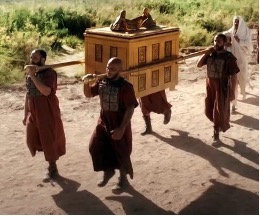
1. Israel was instructed to be alert and sensitive to God. After all—“you have never been this way before” (v. 4). When the priests carrying the ark broke camp to cross the Jordan, the people would know it was time for them to move as well (v. 3). After a three day wait, I imagine most people were ready. Nonetheless, they needed to be paying attention. The text says, “When you see . . .” (emphasis mine)—so they were to be personally watching (as opposed to watching someone who was watching the priests). As disciples of Jesus, God is constantly leading us into new territory, so it is important to pay attention to Him and to what’s going on around us.
2. Israel had to be ready to leave where they were. “When you see the ark of the covenant of the Lord your God, and the Levitical priests carrying it, you are to move out from your positions and follow it” (v.3). For most people three days would not have been long enough to get too entrenched at their campsite. But there were approximately 2.5 million people, so you know there had to be someone who had just set everything up in their tent exactly the way they wanted it and now they were going to have to leave! If we want to stay sensitive to God, we don’t get too attached to anything of this life. We live ready to leave.
Parents, I think this represents a special challenge in raising our children. It’s easy to raise them with the idea of what we want them to be, what we want them to do, and where we want them to go—but that’s not the goal of parenting. The goal of parenting is to nurture, raise, and release our children to God and His purposes for them. They have always belonged to Him primarily and to us secondarily. We are to give them roots to grow and wings to fly.
As they grow, we need to be preparing them to leave. After all, the Bible is barely into the second chapter when it talks about children leaving their father and mother and becoming united to their spouse. We haven’t done our job if we haven’t prepared them to leave us! To do that, we must leave behind our clingy notions that serve us rather than them.
3. Finally, Israel was instructed to honor their God given boundaries. They were told to, “keep a distance of about two thousand cubits between you and the ark; do not go near it” (v. 4). That’s a significant distance—over half a mile.
Like the pillar or cloud and fire, the ark of the covenant represented the presence of God among them. In fact, after the completion of the tabernacle in Exodus 40, the pillar cloud covered the tabernacle and we’re told when it lifted above the tabernacle, Israel would move out. The ark was to be carried by the Levities (and usually it was the priests) and even then, only with poles—they weren’t to touch it. No one else was to go near it.
This command was for Israel’s protection and well-being. Treating what was holy as holy would benefit them in the immediate sense by their life being spared. In the longer term, it would pull them upward as their character and conduct would be shaped to become like the One in whose image they had been made.
We can either strive to take on the image of God or we can make God into our image. The latter was Satan’s strategy in the garden and it’s still popular today. True liberation comes only when we revere God, honor His boundaries, and allow Him to shape us into His image.
 A Taste of Grace with Bruce Green