It’s a little bit of an effort, but it’s certainly worth it to work through the chronology of Abraham. While we can read his story over a few pages and in a matter of minutes, the Genesis material covers 100 years of his life and it’s difficult to fully appreciate his faith or understand his story without some understanding of the time frame.

Abraham was 75 years old when he left Haran for Canaan (Genesis 12:4). God told him He would give Canaan “to your offspring” (v. 7), so he knew he would have descendants. But it didn’t happen over the next few years so when God spoke to him through a vision in 15:1ff, Abraham wanted to know, “What can You give me since I remain childless and the one who will inherit my estate is Eliezer of Damascus? . . . You have given me no children; so a servant in my household will be my heir” (v. 3-4).
The essence of Abraham’s inquiry was this: “I don’t have a son and I’m not getting any younger—so whatever You give me will not go to my descendants but to my servant. How is this supposed to work?” It’s more of a “How are You going to do this?” question than a “Can You do this?” question. It’s the same kind of question that Mary had when the angel told her she would bear a child and she asked, “How shall this be . . . since I am a virgin?” (Luke 1:34).
God didn’t provide Abraham with a lot of details on this occasion. He simply told him Eliezer would not be his heir, “but a son who is your own flesh and blood will be your heir” (Genesis 15:4). He then took him outside, had him look up at the stars in the sky and said, “So shall your offspring be” (v. 5). And Abraham believed everything God told Him!
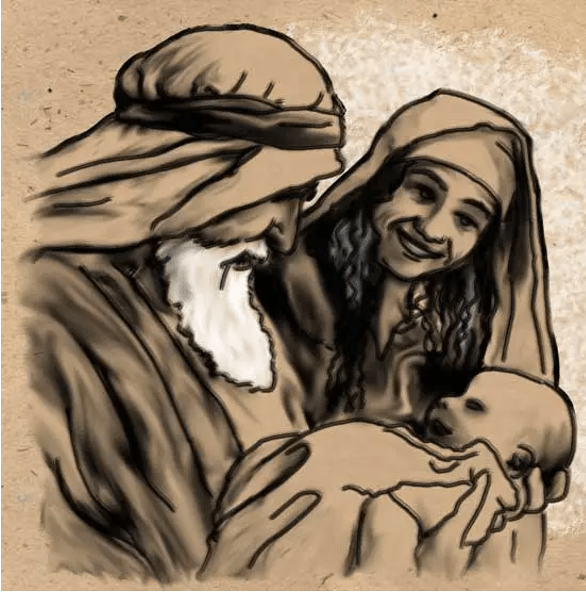
But later he wavered in his belief in that instead of patiently waiting, he decided to take things into his own hands. At Sarah’s suggestion, he had a child (Ishmael) through their servant, Hagar (Genesis 16). Now, at 86, 11 years after entering the land, Abraham had a son. The land could be passed on to his descendants. Problem solved, right?
More like problems had just begun. Abraham and Sarah’s lack of patience didn’t solve anything—it simply created more problems. More to the point—it wasn’t God’s plan. Abraham had to wait 13 more years, until he was 99 before God spelled things out to him in Genesis 17. He was told that in a year, he would have a son through Sarah (17:15-16)! She would be bearing Abraham a son at age 90! Abraham fell down laughing in delight (v. 17).
When Sarah later heard the news (18:10-12), she also laughed. But her laughter was different than Abraham’s—it was the kind of laughter you have when something is too silly to be taken seriously—like if I told you I could fly. She was rebuked for her laughter and God asked, “Is anything too hard for the Lord?” (v. 14).
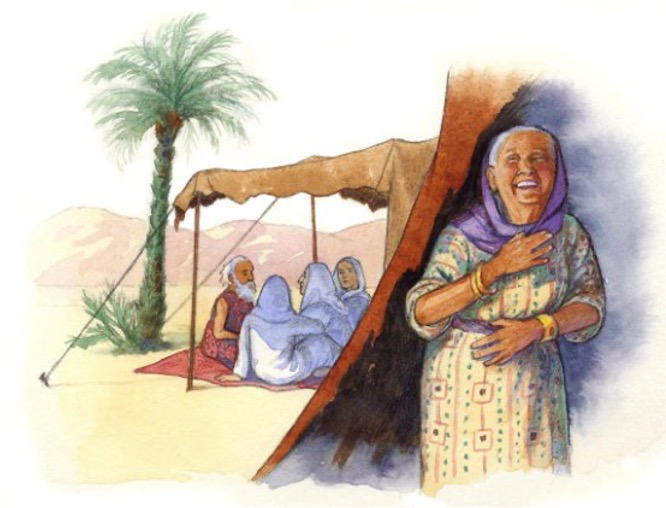
It’s enough to give laughter a bad name!
But we’re not finished with it. Sarah had a change of heart. She took God’s rebuke to heart and realized that the One who made the universe, the One who made her, He was more than capable of giving a son to her and Abraham. The Hebrews writer tells us, “And by faith even Sarah, who was past childbearing age, was enabled to bear children because she considered him faithful who had made the promise,” (Hebrews 11:11).
Notice what Sarah did. She identified her obstacle—her impoverished view of God—that He couldn’t bring a life through a “worn out” body like hers. As God had said to her, “Is anything to hard for the Lord?” With that in mind, she reversed course and “considered Him faithful who had made the promise.” After Isaac is born we’re told that Sarah said, “God has brought me laughter, and everyone who hears about this will laugh with me” (21:6).
That’s how she experienced the happily ever laughter.
 A Taste of Grace with Bruce Green