In chapter 6, the Medo-Persians have taken over after defeating Belshazzar and the Babylonians. Daniel (who had to feel like this was déjà vu all over again), lands on his feet. Darius the Mede (probably a governor/subordinate king—something like Herod was to the Romans) appoints him as one of three administrators over Babylon. Perhaps word had gotten to him about Daniel’s prediction of the Medo-Persians victory (5:26-28). Whatever the case, Daniel does so well under Darius that the king wants to turn everything over to him (v. 3). He was “trustworthy and neither corrupt nor negligent” (v. 4).
This doesn’t sit well with the other administrators and satraps so they do a deep dive into Daniel in an effort to find something they can use against him. Crickets. Daniel certainly wasn’t perfect, but he was blameless in that he was the type of person who always tried to do the right thing and if for some reason that didn’t happen, he would be the first to admit it and correct it immediately. So pinning something on Daniel was like nailing jello to a tree—you just couldn’t do it!
This is the way disciples are to live. We should live in such a way that even our enemies are unable to find something wrong in our conduct. Peter tells the disciples he’s writing to, “Live such good lives among the pagans that, though they accuse you of doing wrong, they may see your good deeds and glorify God on the day He visits us” (1 Peter 2:12). He goes on to tell them. “For it is God’s will that by doing good you should silence the ignorant talk of foolish people” (v. 15). We need more Daniels to salt our world!
What’s sad is that rather than changing their mind regarding Daniel and appreciating that he was worthy of the position Darius wanted to give him, his co-workers went from bad to worse. As the writer of Proverbs notes, “A fool finds pleasure in wicked schemes” (10:23). Their strategy shifts and they decide that because Daniel is righteous, the only way they can get something on him is if “it has something to do with the law of his God” (v. 5). In other words, they decided to use Daniel’s faith against him. That is, by definition, a wicked scheme, but also a backhand compliment to Daniel and his faith.
They go to the king and get him to publish a decree saying that anyone who prays to any god or human being other than the king over the next thirty days would be thrown into the lions’ den. Darius (who must have been more flattered than discerning), goes along with the request and the decree is issued and Daniel, from his co-workers’ perspective, is toast.
But it doesn’t work out that way.
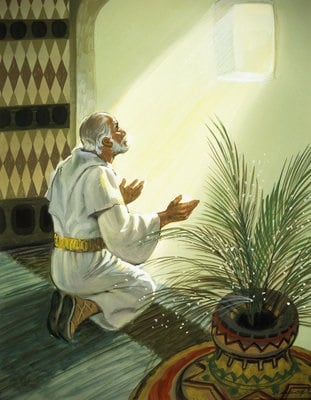
Daniel does the same thing he’s always done—he goes home and prays by the window, giving thanks to God (v. 10). And make no mistake about it—this is where the victory was won. The victory wasn’t when Daniel was rescued from the lions—that was the victory lap. The main course was Daniel’s choice to continue praying, escaping the lions was the dessert. But we don’t always get dessert, do we? And now we’re back to chapter 3 where Daniel’s friends told Nebuchadnezzar that whether they were saved from the fire or not, they weren’t going to bow down to the image.
What we need to see is that like Daniel’s friends, Daniel was leaving the consequences to God. When we were in Romania this summer, I taught English to a lady named Aurelia. In the second week of class, she told me her thirteen-year-old daughter had an inoperable brain tumor. She had leukemia when she was younger and they had lived a year in Rome while that was being treated, but there was no treatment for her tumor. What struck me about this was how she immediately reassured me that her daughter was currently well, enjoying her life, and they were leaving the rest up to God. And she didn’t blink and eye!
If you want to move your spiritual life to a higher level, just start leaving the consequences to God and you’ll be amazed at the power and peace that will flow into your life. The psalmist reminds us that the righteous “Will have no fear of bad news; their hearts are steadfast, trusting in the Lord” (Psalm 112:7).
 A Taste of Grace with Bruce Green