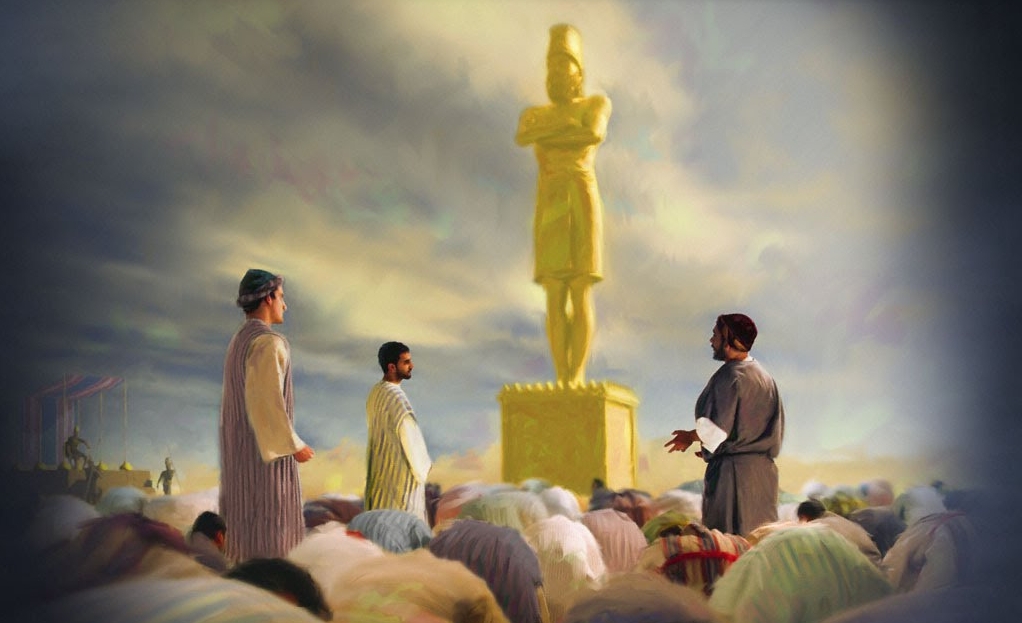
In Daniel 3, Nebuchadnezzar has gathered his advisers, officials, and administrators from all over the kingdom on the plain of Dura (v. 2). Per Daniel 1, this included people from “all of the nations and peoples of every language” (v. 7). The scope of attendees suggests that this gathering was no small thing.
But there’s another layer: Nebuchadnezzar was using the occasion to dedicate a 90’ image he had created. Whether it was the one he dreamed about or something else, we’re not told. What is important was that Nebuchadnezzar was using the image and the occasion as a loyalty test. Everyone who bowed down to the image was “in,” while everyone who didn’t was “out.” And by the way, the people who were out did not have to suffer through the indignity of having to clean out their desks immediately and be led out by security in the march of shame—they would be thrown into a blazing furnace. So the stakes were high!
The other thing worth mentioning is that Daniel was not there. The text doesn’t explicitly tell us this, but that’s the case. The other option is that he is there, he worships the image, and doesn’t come to the defense of his friends—does anyone really believe that’s what happened? That makes no sense. What does make sense is that Daniel is back in Babylon running things while Nebuchadnezzar is away. After all, he’s already passed his loyalty test with flying colors in chapter 2.
From the information Daniel gives us concerning Nebuchadnezzar, he seemed to have been someone people had to constantly prove their loyalty to. That can be exhausting and in the case of Daniel and his friends—dangerous. He was also the type of person who provided others with multiple opportunities to do what was wrong. Now now on the plain of Dura, he was making it easy to do what was wrong. It’s people like Nebuchadnezzar who inspired the saying, “With friends like that, who needs enemies?”

What would Shadrach, Meshach, and Abednego do? They were young and away from their home. They were away from their friend, Daniel. It would have been oh-so-easy for them to entertain the idea of giving in to the king’s demand. After all, who would know?
Or, they could have rationalized their situation in a different direction—a practical one. They could have bowed down physically just this once—but not bowed down in their hearts. And they would only bow down so that God could continue to use them to influence this pagan king. It’s an ends justifies the means kind of argument that we might be tempted use to convince ourselves that participating in something wrong is for “the greater good.” I’ll laugh at this crude joke, nod my head at this lie, or compromise in some other way because I want to be “in” with this person or group of people so I can influence them for Christ. How does that work out for us? Has compromising our beliefs ever been a successful form of outreach?
The young men did not use being young, being away from home, or anything else as an excuse to bow down.
1. They understood the simple truth that doing right is never wrong, so they don’t need to defend themselves before the king or anyone else (v. 16). While there’s something to giving a reason for the hope that we have (1 Peter 3:15), it needs to be balanced with the truth that sometimes actions speak louder than words. This was one of those times.
2. The did the right thing for the right reason. Verses 17-18 make it clear that the young men had no doubt about God’s ability to rescue them, but they also had the maturity to understand and accept that He may not choose to do this. (This puts us to shame with some of the things we’re unwilling to accept). So, they weren’t defying the king because they knew they would be rescued, they were obeying God because it was the right thing to do. Period.
3. They left the consequences of their actions to God. They didn’t know what was going to happen, but they knew the God they bowed down to was in control and in the end, everything would be okay. We would do well to remember if everything isn’t okay right now, it’s because we haven’t reached the end yet.
I wonder how these young men came to have such faith? Were they raised in a family where God was honored above everything else? Or is it possible that they grew up in a compromised environment—certainly many existed in Judah—where idols were given equal standing or superior standing to God? If this was so, perhaps they came to God as a result of the captivity. Or, it could be possible, I suppose, that everyone but Daniel was in some lesser state of following God when they started their training in Babylon. If so, then Daniel’s actions (he is the only one mentioned as requesting the special diet – 1:8ff), and the consequent results convicted them and stirred them to faith.
We have no way of determining how these young men came to their faith. Maybe it was different for each of them. But if it was important, we would know. The fact that we don’t reminds us that people can come to faith under just about any kind of circumstance and what matters most is that they make the choice to follow God. As you read this, you might have had a smooth path or a rocky road to your faith, it doesn’t matter. All that is important is that you have made the choice to follow Him as these young men did.
 A Taste of Grace with Bruce Green