

The word “righteous” occurs seven times in the five chapters of James’ letter. It is a word that summarizes well James’ down-to-earth approach and overlaps with Jesus’ instruction in Matthew 5-7 where a major focus is righteousness (5:20, 6:22). His use of the word in his letter falls into four categories.
1. There is the righteousness of Spirit-controlled communication.
The first occurrence of righteousness is in 1:20, where he reminds his readers that “human anger does not produce the righteousness that God desires.” He has just told them to be “quick to listen, slow to speak and slow to become angry” (v. 19). These are words of wisdom that ring as true now as they did twenty centuries ago.
Listening for many people (including myself), can be one of the most challenging things in the world. Why? There are several reasons. People don’t always communicate well or clearly. They may ramble and take forever to get to their point. Nonetheless we are to discipline ourselves to listen—always being attentive to tone of voice, body language, as well as any new information they are sharing. The writer of Proverbs tells us, “He who answers before listening—that is to his folly and his shame” (18:13).
Being “slow to speak” means we take some time to consider our response. Our concern should be more than just replying in way that brings us gratification—we should try to frame our words in a way that is most helpful to the person or people we’re speaking to. Again from Proverbs, “The heart of the righteous weighs its answers” (15:28), and “A man find joys in giving an apt reply—and how good is a timely word!” (15:23).
We are also to be “slow to anger.” James puts his finger on one of the principal reasons people vent their anger rather than control it—they are under the impression that by doing so they are being righteous. The way this usually works is we think I’m right, you’re wrong, so stand back because I’m about to cover you with my righteousness. But as James points out, what makes us feel righteous isn’t always righteous behavior. What makes us feel good, isn’t always good. An uncontrolled spirit does not achieve “the righteousness that God desires.”
2. There is the righteousness of a fruitful faith.
The next four occurrences of righteous are clustered in James’ discussion of faith and works (2:14-26). The theme of an active faith runs through the letter (1:22-25, 2:14-26, 4:17). In 2:14 it is a fragmented, unhealthy faith that is under consideration (i.e., one with faith but no deeds). Can such a faith save? Is that faith legit?
The answer is clearly “No.” James illustrates this with two very different people, Abraham and Rahab.
Any Jewish person would know that Abraham was declared righteous on the basis of his faith in Genesis 15. You remember that God brought him out on that starry night and told him that his descendants would be as numerous as the stars. Abraham believed God “and He credited it to him as righteousness.” He didn’t “do” anything—he just believed in what God told him. It doesn’t take much imagination to see how this becomes twisted to mean that faith doesn’t require you to do anything—you just have to believe. Maybe this was even making the rounds in James’ day.
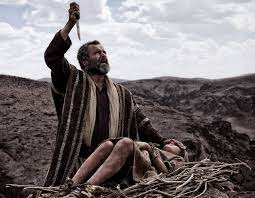
If so, he absolutely buries it by pointing to an event later in Abraham’s life—when he took his son, Isaac, to Mt. Moriah to offer him as a sacrifice, as God has instructed him to do (22:2). James identifies Abraham’s actions as righteous (v. 21), but he drops the bomb when he tells his readers in v. 23 that, “The Scripture was fulfilled that says, ‘Abraham believed God, and it was credited to him as righteousness,’ and he was called God’s friend.”
This is, in effect, an inspired commentary on Scripture. James is saying that in some sense the events of Genesis 22 fulfilled Scripture’s statement in 15:6. But how?
The word fulfill means to “fill full.” When Micah declared that the Christ would be born in Bethlehem Ephrathah (5:2), it was true for the world to believe the moment he wrote those words. However, it wasn’t fulfilled until Jesus was born of Mary in Bethlehem centuries later. You can think of it like a glass and the liquid that fills it. The glass is made to be filled—you can see that from its design. When it is filled, there is a completeness, a harmony between the ideal (what it is made for) and real (what it is).
In the same way, the Scripture’s declaration in 15:6 that Abraham believed God was the glass. What happened years later at Moriah filled the glass. I think that one of James’ points in all of this is that it is wrong to assume that Abraham’s faith at the time of Genesis 15 was limited only to believing. What was limited was his opportunity. God didn’t require him to do anything other than believe His promises (which in and of itself was daunting). Had God commanded him to sacrifice his son, James’ point is—the faith to do so was there (though the son wasn’t)! The faith for the actions of Genesis 22 was present in Genesis 15. Thus, when the opportunity came, Abraham obeyed, and the truth stated in 15:6 was fully manifested in his actions at Moriah. Faith can be full and complete even though the opportunity to express itself may not yet exist. Rahab is brought in possibly to show the breadth of this. For the Gentile as well as the Jew, a fragmented faith doesn’t get the job done. The faith that saves is the faith that obeys and results in righteousness.
3. There is the righteousness of peacemakers.
The background for James 3 appears to be the conflict between the unrighteous rich and the oppressed poor that spans the book (1:9-11, 5:1-9). The rich had their position and their power (see 2:6, 5:6). The poor had their words—which they weaponized (1:19-21,26, 2:12-13, 4:11-12, 5:9). James 3 brings teachers into this conversation. It’s possible they were being recruited to weaponize their words as well.
James not only moves them away from this, he also points out that “the wise” (what every teacher would aspire to be), should practice a heavenly wisdom that is “peace-loving” (v. 17). Those who sowed in peace would “reap a harvest of righteousness” (v. 18). In many ways, this is the result of carrying out what James first talked about in regard to righteousness (being quick to listen, slow to speak and slow to anger).

We live in a world where some people make it their pastime to be outraged. Social media is brimming with people who have weaponized their words and looking for more people to target. More than ever, we need to seek to be “peacemakers who sow in peace a harvest of righteousness.”
4. There is the relationship between righteousness and prayer.
Finally, there is the truth that, “The prayer of a righteous person is powerful and effective” (5:16). In the context, this is offered to encourage confession of sin to each other and prayers for healing. This is what a community led by the Spirit looks like.
 A Taste of Grace with Bruce Green