“You can be anything you want to be!”
Have you ever heard this? Just kidding. Would you like to have a dollar for every time you have? Now we’re talking, right?
These words are usually spoken in complete earnestness and with the absolute best of intentions. They can be found in books occupying the bestseller lists, heard from educators, coaches, parents, grandparents, and your best friend.
None of that changes their falsehood or their potential harmfulness. None of that changes the idolatry that’s involved in this belief.
There are a couple of major problems with this concept. One is that this assumes that if we have enough intensity of desire (i.e., passion), we can do whatever it is we want to do. With this assumption, we treat our passion as if it has transcendent ability (idolatry). It becomes our superpower. Because we have passion, nothing can stop us. This includes those things we don’t have control over: the actions of other people, our health, our experience, the limited amount of time and energy we have, etc. Passion is a great thing to have, but it’s not omnipotent and thinking it is doesn’t make it so. It has limits and part of living in the real world is recognizing that.
Speaking of limits, a second problem is the limited nature of opportunities. You can be anything you want to be, so let’s say you decide you want to be president. You must be 35 to be president. Being generous, let’s say that gives you a window of 50 years in which to accomplish this. Do you know how many presidents there have been in the last 50 years? Nine. That’s it.

Let’s pose a not so hypothetical hypothetical—do you think there are currently more than nine people, who more than anything else, desire to be president? I do too. Do you think all of them will be president? I don’t either. That’s the second problem with the idea that you can do anything you want to be. The math just doesn’t work whether you’re talking about being president, an NBA player, gold medal winner, Nobel Prize recipient, Oscar winner, etc. Those pesky limits.
Unless . . .
Is it possible we are looking at limits the wrong way?
Let’s come back to that.
At this point, we can say that it should be clear that we cannot be anything we want to be. To varying degrees, you can be some of what you want to be, but no one can be everything. It just doesn’t work that way and anyone that tells you pr anyone else that it does isn’t doing you any favors.
A further look at limits
Now back to looking at our limits.
What if a limit isn’t really a limit? What if a limit is a good thing?
Is that even possible?
It could be. What if there was One who is everything we are not (i.e., transcendent). And, what if this One oversaw things in such a way that everything worked out for the good for those who loved Him? (Romans 8:28).
Does that sound too good to be true?
Or is it too good not to be true? (Isn’t it amazing how willing we are to believe that if we just had the power, everything would be great, but we are unwilling to grant this possibility for God? Why is that?).
But God is more than a nice philosophical idea, He’s the core reality of everything. And the truth is, we need Him at every level of our lives. We need Him at an elemental physical level—“in Him we live move and have our being” (Acts 17:28). Whether we care to acknowledge it or not, He is involved in every beat of our heart and every breath we take. We need Him relationally. “Know God, know peace. No God, no peace. “ And we need Him to be the best version of ourselves. After all, how can we even know what that is if we don’t acknowledge the One who created us and provides redemption for us? Like the prodigal son, we don’t come to our senses until we make the decision to come to God (Luke 15:17).
There is something better than being everything we want to be—it’s being everything God wants us to be. If we are everything God wants us to be, then we can live with whatever “limits” we might have because we know God is using them for our ultimate good as well as for the good of others (2 Corinthians 12:1-10). That’s truly the best version of ourselves!
Worthy of our passion
Most people recognize the need to find something worthy of their passion. They have the right idea, just the wrong expression. They need to find Someone worthy of their passion. That Someone is Jesus Christ.
Why?
Because of who He is (the Son of God) and what He does. He died on the cross to reconcile us to God and lives to make intercession for us (Hebrews 7:25). He came that we “may have life, and have it to the full” (John 10:10). He knows us intimately and loves us ultimately. He is Someone worthy of our passion.
He also made it unequivocally clear that we could not be His disciples without giving up everything (Luke 14:33). That’s e-v-e-r-y-t-h-i-n-g.
So how does that work?
Two stories
As we noted, we can’t be anything we want to be, but we can be anything God wants us to be. And God wants us to take up our cross and follow Him. Those are the terms, and they are non-negotiable. As C.S. Lewis noted, there’s really no other way to follow Jesus. Think of it like this: trying to follow without surrendering is like trying to drive a car by putting it in neutral, sticking a leg out the door and pushing off with your foot. That’s not how a car is designed to work, and we will exhaust ourselves trying to get anywhere. Jesus is Lord of all or He’s not Lord at all.
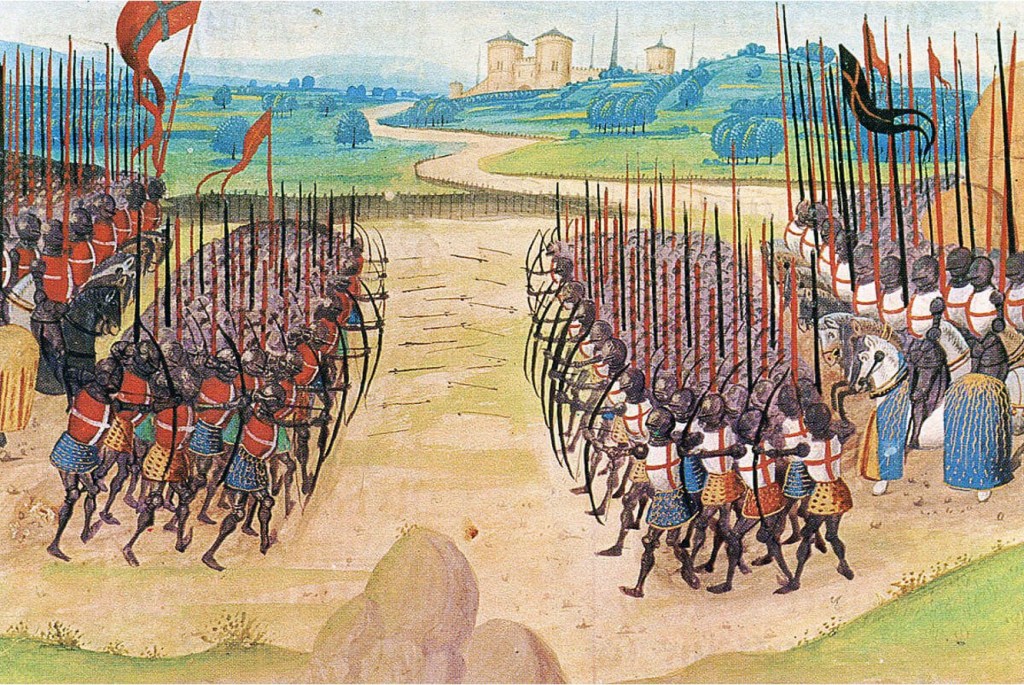
In Luke 14:28-32, Jesus shares two brief stories about following Him. The first is about someone who plans to build a tower and the need for them to calculate the cost of doing so. The second story concerns a king preparing for war against another king. Only his enemy has twice as many troops as he does. All things being equal, this is not a good move—the smart thing to do is to surrender.
The tower story is simple and straightforward. Its purpose is to get us, like the builder, to count the cost of being a disciple of Jesus. As with the tower, the time to do this is not after you have started, but before you begin. The decision to follow Jesus is a serious one and we need to treat it that way.
The second story is more involved. It is not only about counting the cost, but it gives a course of action—surrender. What isn’t initially as clear is how this fits in with Jesus’ message up to this point which has been about loving Him more than anyone (v. 26) and carrying our cross (v. 27). Verse 33 spells it out as He says, “In the same way, those of you who do not give up everything you have cannot be My disciple.” Like the king, we are to surrender. So loving Jesus more than anyone/carrying our cross = surrendering to Jesus.
Fighting against God or with Him?
But there’s something else worth thinking about here. In the parable, the king surrenders to a greater king. We are to surrender to Jesus. It’s not a huge leap to make the greater king of the parable Jesus. After all, we are clearly the lesser king in the story. The parable becomes poignant because it suggests as long as we are trying to follow Jesus on our terms, we are not only fighting a battle we cannot win—we are fighting against Him!
It’s not unusual to see this sort of thing—people fighting against God. They want to follow Jesus, but they want to do it on their terms, not His. There’s some part of their lives they want to retain control over, so they resist, rationalize, or simply reject what God has said. Perhaps they speak of it as “living out their own truth.” They might act like everything is okay, but deep down inside they know it’s not. They don’t have peace and won’t have peace as long as they are fighting against God in this way.
Our surrender to God doesn’t remove conflict from our lives, it reorients it. We’re no longer fighting against God; we’re fighting with Him against the forces of evil. But our surrender means that we’ve opened up our lives for God to work in and through us. So Paul will speak of how disciples “continue to work out your salvation with fear and trembling (i.e., reverence – BG), for it is God who works in you both to will and to act in order to fulfill His good purpose” (Philippians 2:12-13). We work out because God works within and that makes all the difference in the world!
The paradox of faith
By losing our life through surrender to God, we find it. This is the great paradox of faith. Without faith that sounds totally limiting, but with faith we understand it is totally liberating. (Notice that I didn’t say totally easy). We trust that in letting go of our life, God will provide us with a glorious new one. Jesus spoke to this when He said, “Unless a kernel of wheat falls to the ground and dies, it remains only a single seed. But if it dies, it produces many seeds” (John 12:24).
We understand that whatever God has blessed us with physically, relationally, materially—it all belongs to Him, and we trust His reign over those things. To live this way is to live with a pure (single) heart that seeks God’s kingdom above all (Matthew 5:8, 6:33). To live this way is to live as salt, and it is “good” for us and for the world (Luke 14:34).
 A Taste of Grace with Bruce Green